Live · MVP — Real Estate Intelligence

Ask your portfolio a question.
Get a fact-based answer, not a guess.

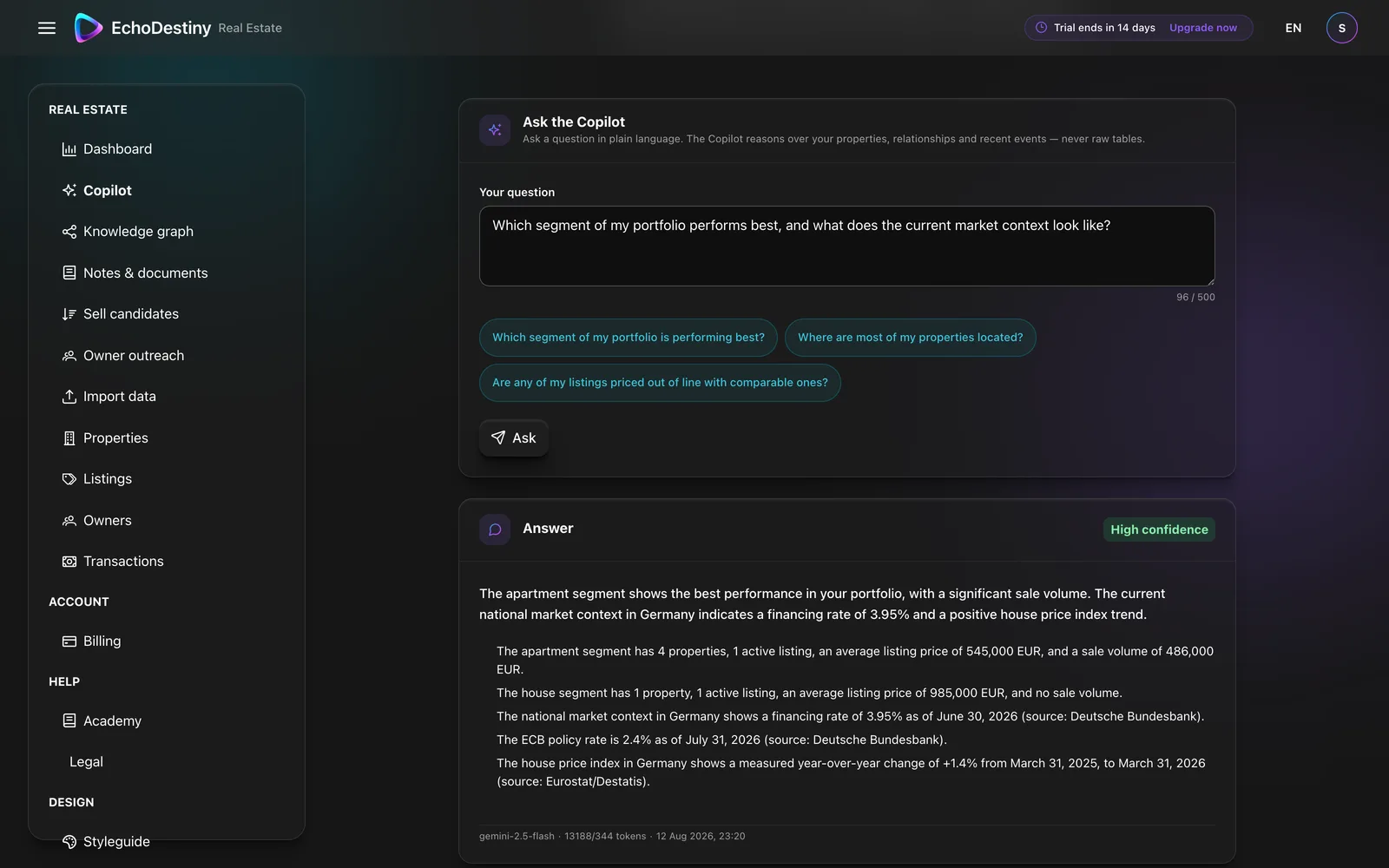
EchoDestiny Real Estate Intelligence gives you an agentic copilot you talk to in plain language. It understands your question, selects the right grounded tools — your own transactions and listings, official market indices, OSM-based location data — and returns an analysis built entirely on real data. Every number traces back to a source. Where a source is missing, the copilot says so. Then it proposes an action. Your team approves it.

GDPR-compliant · 100 % EU hosting · Human-in-the-loop · Made in Germany

Live property graph
Grounded AI analysis
100 % EU hosting

The Problem

Real estate decisions run on fragmented data

Most real estate operations manage data in at least three different places. Listings in one system. Owner and contact history in the CRM. Transaction records in a spreadsheet. Market data pulled manually from a portal every few weeks.

When a question comes up — "Is this property priced correctly?" or "Who else in the portfolio has a similar profile?" — the answer requires exporting, merging and interpreting files across all of them. It takes hours. The result is still a gut call.

Valuation models that ignore ownership history, transaction context and local market signals are not models. They are averages dressed up in Excel.

  • Property, owner and transaction data in separate systems — no connection between them
  • Comparable analysis done by hand, using keyword searches and gut feel
  • Market pricing based on broad averages, not the specific relationship context of each object

The Solution

A knowledge graph with an agentic copilot on top

What is Real Estate Intelligence?

EchoDestiny Real Estate Intelligence is an ontology and AI platform that structures property data as a typed knowledge graph — and puts a facts-first agentic copilot in front of it. You ask a question in plain language. The copilot decides which grounded tools to call: your own portfolio data, official market indices from Destatis and the Bundesbank, OpenStreetMap-based location scores, and official land values where available. Every statement in the answer traces back to a tool result. The copilot never draws on AI training knowledge for facts — if a required data source is not connected, it says so explicitly rather than estimating.

Relationship examples

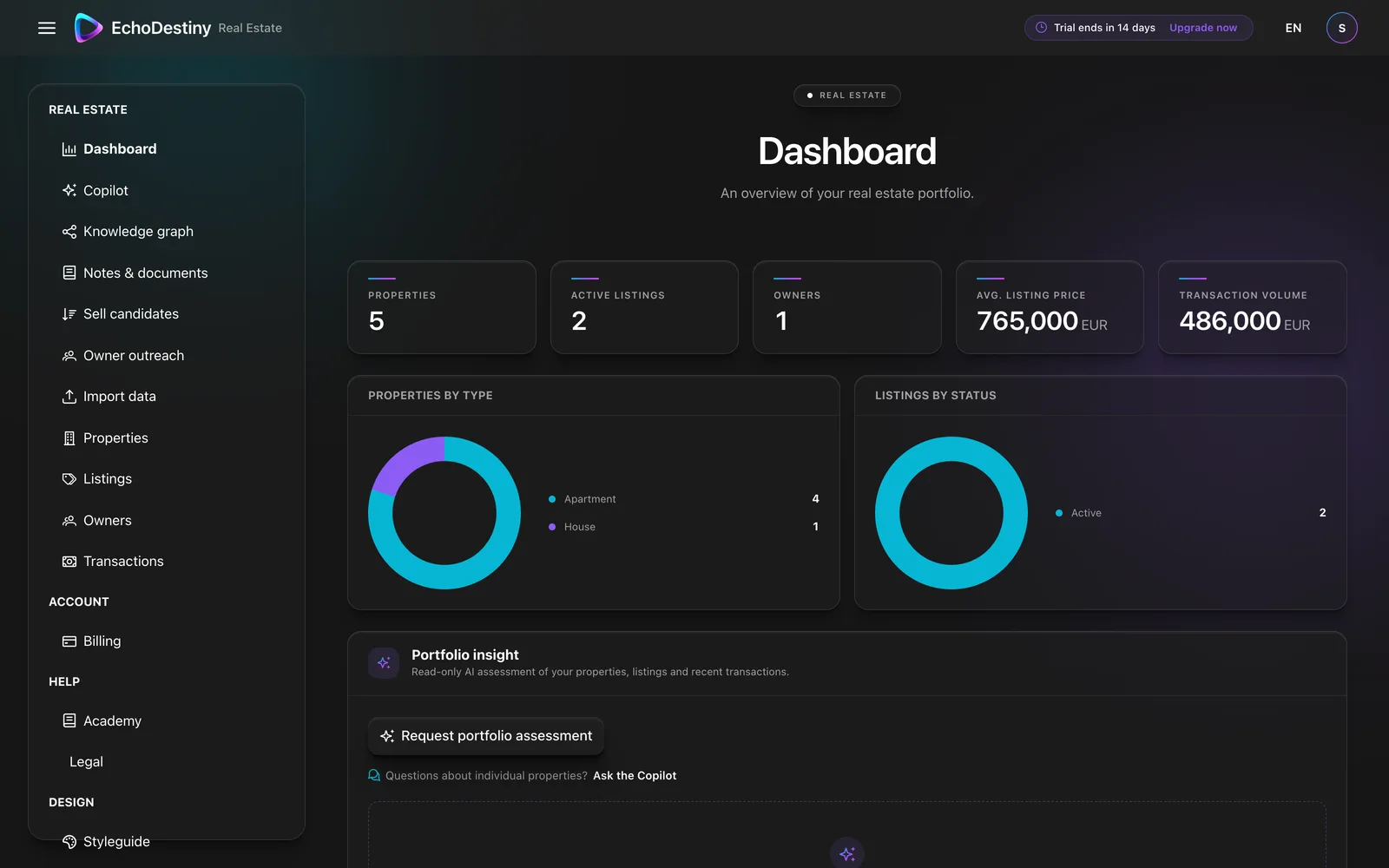
ownssold viapriced bycomparable tosignals

Capabilities

Six ways the graph becomes intelligence.

Every capability operates over the same typed graph — so a valuation, a comparable search and a market analysis share one consistent, source-traceable picture of your portfolio.

Agentic Copilot — Grounded, Facts-First

Ask anything about your portfolio in plain language. The copilot understands the question itself, selects the grounded tools it needs — portfolio analysis, comparable pricing, official market data, location scores — and builds its answer exclusively from tool results. No number comes from AI memory. Where a required source is not connected, the copilot tells you honestly instead of estimating. The result: a transparent, source-traceable analysis and a proposed next action for your team to approve.

AI-Powered Property Valuation

Instead of a price-per-square-meter average, EchoDestiny computes valuation with the full ontology context: comparable sales in the area, ownership history, transaction timing and market signals — all weighted by the relationships that matter for this specific property type and location. The AI proposes a valuation range with its reasoning. Your team reviews it.

Semantic Comparable Search

Finding comparable properties by filtering on bedrooms, size and postcode gives you a list. Semantic comparable search gives you relevance. EchoDestiny uses locally-run embeddings to understand the meaning of each property profile — and surfaces the objects that are genuinely similar, including ones a keyword filter would miss.

Market Context — Official Sources

The copilot pulls market context from integrated official sources: the mortgage effective interest rate from the Deutsche Bundesbank and the annual house price index trend from Destatis (additionally Eurostat HPI as a cross-check). Where available, official land values (Bodenrichtwert) come from BORIS — currently covering Berlin. These are measured values as of their respective reference date, not forecasts. The copilot states the reference period and notes when only national figures are available, not city-level data.

Owner & Transaction Graph

Who owns what, who sold to whom, which properties have changed hands multiple times in short succession — these relationship patterns are often the most commercially relevant signals in real estate. EchoDestiny makes the ownership and transaction graph navigable, so your team can identify concentration risk, off-market opportunities and relationship-based leads.

Roadmap

Satellite Data Analysis

EchoDestiny will integrate open-source satellite imagery — Sentinel-2, Landsat — to enrich property context with land use, green space, infrastructure proximity and visible neighborhood change over time. This is a planned capability, not a live feature. It will give Real Estate Intelligence a location-analysis dimension that no spreadsheet can replicate.
How it works

From a plain-language question to an approved action in five steps.

01

Connect your property data

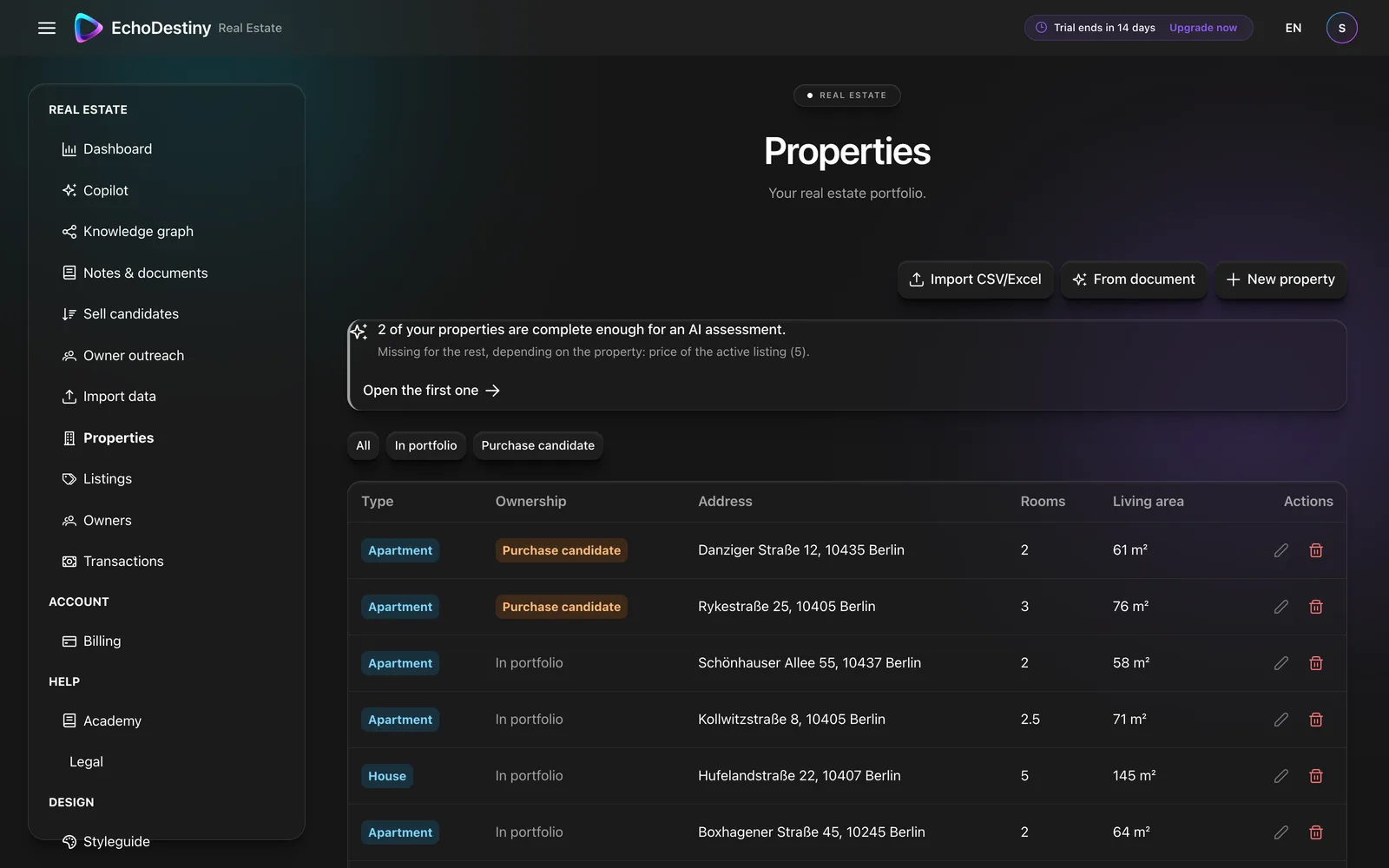
Upload a CSV with your listings, portfolio or transaction history. The connector guides you through mapping each column to the right ontology field — Property, Owner, Listing, Transaction. No data engineering required.

02

EchoDestiny builds the graph

The platform resolves entities, detects relationships — which owner holds which properties, which transactions link to which listings — and assembles a typed knowledge graph. Embeddings are computed locally for comparable search.

03

Ask a question in plain language

Type a question: "Which properties are priced below the segment median?" or "What is the current mortgage rate context for this market?" The copilot understands the question and selects the right grounded tools — your own data and connected official sources. It never draws on AI training knowledge to answer factual questions.

04

AI surfaces source-traceable insights

The answer comes back with reasoning: which tool results drove each finding, which relationships were followed, where confidence is high and where data is sparse. If a required source is not connected, the copilot states this explicitly. Not a black box — a transparent, source-traceable analysis.

05

Review the proposed action and approve

EchoDestiny proposes what to do next — flag a property for repricing, shortlist it for an outreach, add a note to the owner record. Your team reviews the proposal and approves it. Nothing executes without a human sign-off.

Use Cases

Questions Real Estate Intelligence can answer

These are the kinds of questions the platform handles directly — in plain language, grounded in your data and connected official sources, with a proposed next step.

“Which properties in my portfolio are priced below the current segment median?”

The copilot queries transaction history and current listing data for comparable objects in the same segment and location radius, then computes the deviation of each portfolio property from the segment median in percent.

Flag the three most undervalued properties for a repricing review.

“What is the current official land value for this property in Berlin, and how does our listing price compare?”

The copilot retrieves the official Bodenrichtwert (land value in €/m²) from the BORIS portal — the last published official figure for that address. Berlin is currently the covered region. Outside that coverage area, the copilot states clearly that no official source is connected rather than estimating.

Attach the official land value reference to the property record.

“How does the national house price trend affect our pricing strategy right now?”

The copilot calls the market context tool, which pulls the annual house price index change from Destatis (with Eurostat HPI as cross-reference) and the current mortgage effective interest rate from the Deutsche Bundesbank. These are measured values as of their respective reference date — the copilot names the period and notes that national figures do not automatically apply at city level.

Attach the market context summary to the next investment committee report.

“Find comparable two-bedroom apartments sold within 3 km in the last 12 months.”

Semantic comparable search uses embeddings to find objects with similar profiles — size, type, condition signals — not just matching filter values. Results include confidence and the relationships used.

Export the comparable set to a valuation worksheet.

Example proposed action with human approval

Proposed action

Flag 3 undervalued properties for repricing

Based on the segment-median comparison, three properties sit 8–12 % below the median for their segment. The AI recommends a repricing review.

Runs only after your approval. Nothing executes automatically.

The Platform

One foundation, more intelligences.