Is Shopify good for SEO?
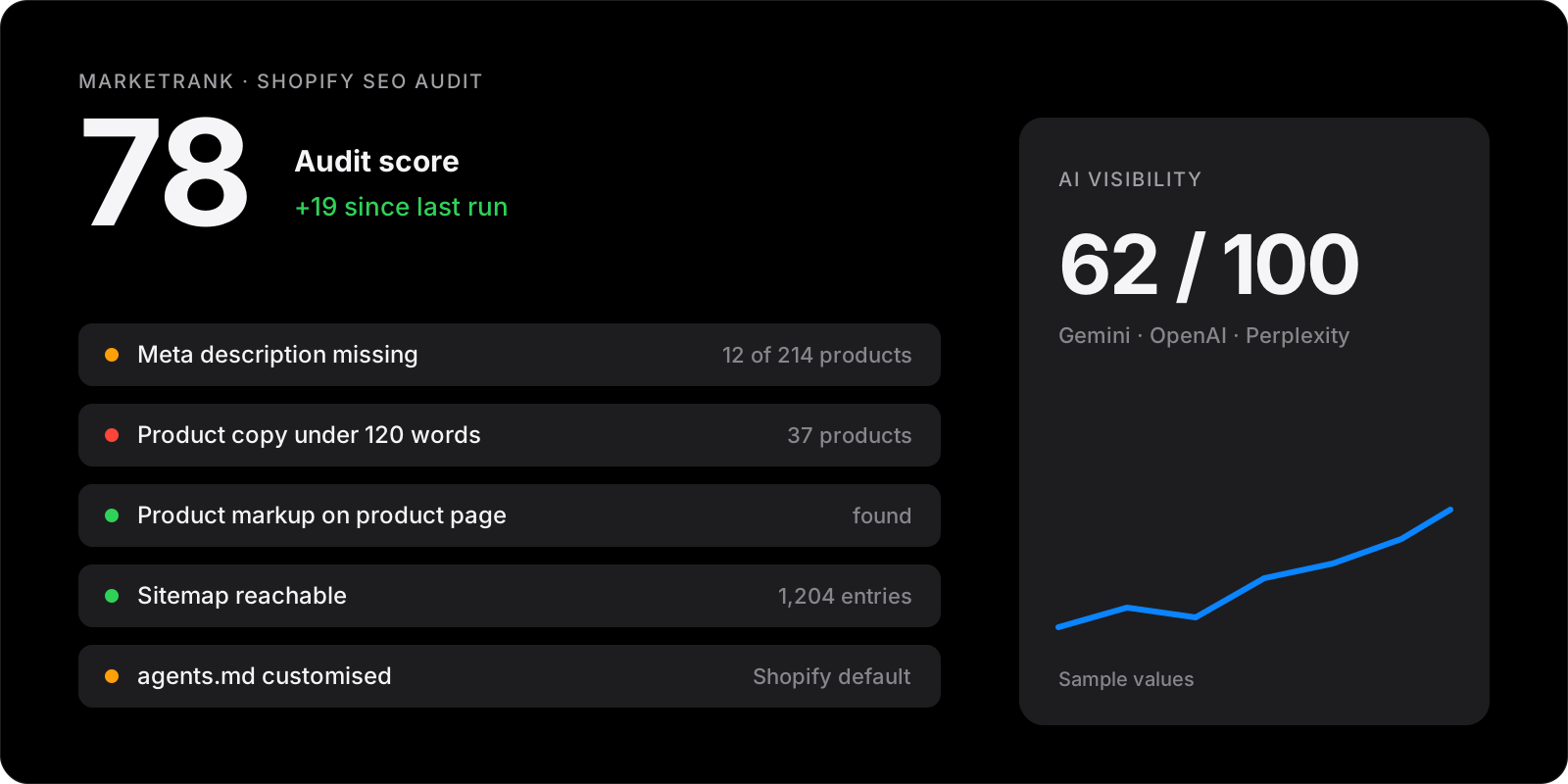
Yes, the technical base is good: Shopify generates sitemap and canonicals automatically, serves clean URLs and fast pages, and since 2026 also agents.md for AI crawlers. The gaps are in the catalog: meta titles and descriptions are often empty, product copy is pasted from manufacturers, structured data depends on the theme. MarketRank checks exactly these gaps and proposes fixes.
Does Shopify have good SEO out of the box?
Partly. Shopify offers fields for meta title, meta description, URL handle and alt text, plus sitemap, robots.txt and canonicals. It does not check whether those fields are filled, how long the text is, or whether products share duplicate descriptions. MarketRank measures exactly that across the whole catalog and returns a score with history.
How is MarketRank different from other Shopify SEO apps?
Three things: the score is measured, not estimated — every point traces back to a rule and a specific product. Nothing is written to the store without your approval, never automatically. And AI visibility is documented with stored answers instead of a chart without a source. On top of that, the interface and the generated copy are available in German as well as English.
What is an AI visibility score?
An AI visibility score summarises how often and how prominently AI assistants name a store in answers to buyer questions. MarketRank calculates it from three measured values per answer: mention, rank among the providers named, and citation as a source. The score is shown per question, per engine and over time, and every underlying answer can be opened as evidence.
Do Shopify tags help SEO?
Not directly. Product tags organise your catalog and power filters, but Google does not treat them as ranking signals, and tag pages under /collections/all/tag are thin, near-duplicate pages. What helps is the product page itself: title, meta description, unique copy and alt text. MarketRank measures those per product and leaves tags alone.
Is there a free AI visibility checker for Shopify?
Yes. The free plan of MarketRank runs five buyer questions against one AI engine every month and stores each answer as evidence with timestamp and sources. Paid plans add questions, engines and weekly or daily runs. There is no separate sign-up; it installs from the Shopify App Store.
How does SEO work on Shopify?
Shopify renders each product, collection and page with a title, meta description, canonical and sitemap entry, and search engines crawl those like any other site. What you control is the content of the fields and the copy on the page. MarketRank reads every product and collection through the Shopify API, checks the fields against fixed rules, and after your approval writes the corrected values back.
What is MarketRank?
MarketRank is a Shopify app by EchoDestiny for SEO and AI visibility. It audits your store deterministically against more than 25 rules (meta titles, descriptions, product copy, structured data, robots.txt, sitemap, agents.md), proposes fixes you approve with one click, and then measures whether ChatGPT, Gemini and Perplexity recommend your store — every answer stored as evidence.
How is the audit score calculated?
The score from 0 to 100 is the weighted share of rules passed. Every rule carries a fixed weight between 2 and 10, partial failures count proportionally, and rules without a measurable value do not count at all. No figure comes from an AI estimate — every point traces back to a concrete measurement in your store.
Does the app write to my store without my approval?
No. MarketRank generates suggestions and shows before and after. Nothing is written until you approve a suggestion. Before writing, the current value is read again; if the product changed in the meantime, nothing is overwritten.
What does AI visibility mean — and what is measured?
From your catalog, MarketRank generates 10 to 25 typical buyer questions without naming your brand — the way someone asks who does not know you yet. These questions are sent on a schedule to the APIs of Gemini, OpenAI and Perplexity. For each answer, mention, rank and citation are measured; together they form a visibility score with history.
Is that the same as what a customer sees in ChatGPT?
Not word for word. The answers come from the model APIs with web search, not from the consumer interface. MarketRank says so openly: every answer is stored as a "model API response" with timestamp and sources. That is a reliable, repeatable piece of evidence — not a screenshot.
Where does the text in the suggestions come from?
From the facts of your product: title, vendor, type, tags, price range and existing copy. The AI is not allowed to invent anything; every suggestion is checked against fixed rules before it is shown (meta title up to 60 characters, meta description 120 to 155 characters, product copy 120 to 220 words). A suggestion that fails the check is discarded, not displayed.
Which language does MarketRank write in?
Generated store copy is written in the primary language of your store, not in the language of your admin. The app interface is available in English and German.
Which permissions does the app need?
Only products and collections (read and write), pages and blog (read), theme files (read) and store locales (read). MarketRank reads no customer data and no order data.
Where is my data processed?
In the EU. Database and application run in Frankfurt, AI calls run in EU regions. Raw model responses are deleted after 90 days; the scores remain. On uninstall, all store data is removed.
Can MarketRank change my robots.txt or llms.txt?
Shopify has served agents.md and llms.txt itself since 2026, and robots.txt can only be adjusted through the theme template. MarketRank checks whether the files exist and are customised, provides a ready template and instructions for inserting it — it does not modify your theme files itself.
What does MarketRank cost?
The audit is free in every plan and can be run as often as you like. The free plan also includes monthly visibility runs with five questions. Starter ($19), Growth ($49) and Pro ($99 per month) increase questions, engines and frequency up to daily runs. Billing goes through Shopify, cancel any time.
How fast do I see a result?
The first audit runs right after installation and takes under a minute for a typical store. Suggestions appear in seconds per click. The first visibility run is ready within minutes, and the history grows with every scheduled run.