Knowledge graph
Every property, owner, company, listing, region, transaction, event, AI insight, note, and suggested action as a connected node.
Platform Intelligence · Knowledge Layer
The Second Brain is EchoDestiny’s shared knowledge layer: a knowledge graph, permanent notes and documents, and a grounded AI copilot in one searchable system, so nothing about your business lives only in someone’s head or inbox. It’s built deterministically from your real data — no part of the graph is generated or invented by an AI model. The Second Brain is live first in EchoDestiny Real Estate Intelligence, built to extend into every module as the platform grows.
In most companies, knowledge scatters across emails, spreadsheets, and whatever the person who was in the room remembers. The Second Brain keeps it in one place — a knowledge layer built on three parts, shared across the platform:
Every property, owner, company, listing, region, transaction, event, AI insight, note, and suggested action as a connected node.
A permanent store for what you write down, kept until you delete it.
Ask a question in plain language, get an answer sourced from your own notes and data.
New team members see how everything connects from day one, instead of asking around for context that lives in someone else’s inbox — whichever module they’re working in.
The knowledge graph is a live, interactive map of every entity your business touches — 2D or 3D — with relationships like "owns," "located in," "comparable to," or "led to" connecting them. In Real Estate Intelligence, that means properties, owners, companies, listings, regions, transactions, events, AI insights, notes, and suggested actions as nodes; the same graph engine carries into every module that follows.
It’s projected directly from your database. No language model draws or interprets the graph — what you see is what actually exists in your data, updated as your data changes.
Click any node to focus on it and see its details. Analysis tabs show topic distribution, the most connected nodes, gaps where a part of your portfolio has no connections yet, and network metrics — computed from the graph itself, never predicted by a model.
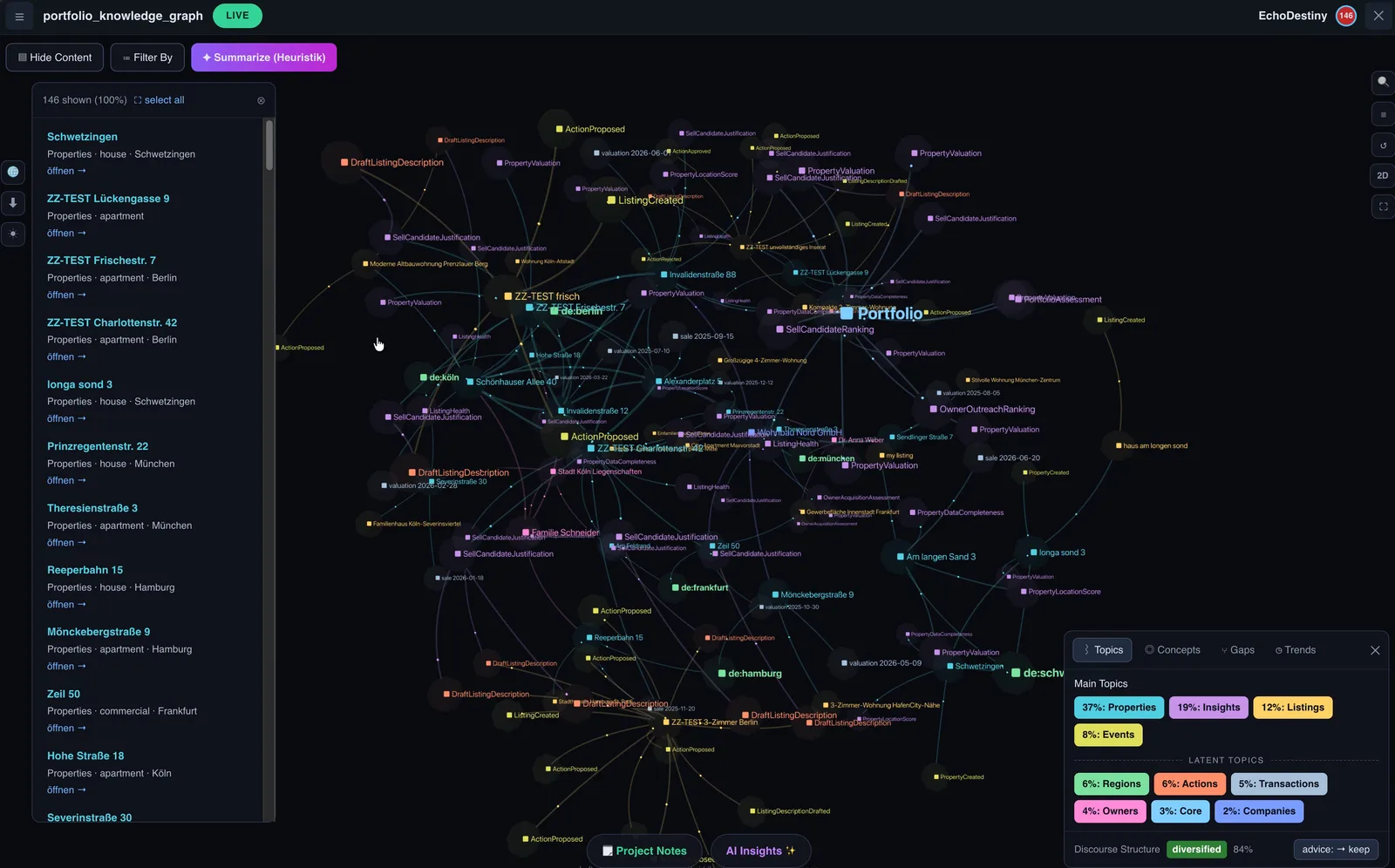
Projected straight from your data, not modeled by AI.
Select any node to see what it’s connected to.
See which parts of your portfolio are still disconnected.
Write a note on a property, a customer conversation, a site visit, or any project you’re tracking — up to 200,000 characters — and it appears automatically as a node in the knowledge graph, linked to the rest of your data. It’s not a separate app you have to remember to check; it’s part of the same map.
Delete a note and it’s gone for good in a single transaction — the note itself and every embedding generated from it are removed together. Nothing lingers. Until you delete it, it stays available to search and to the copilot.
Long enough for a full due-diligence write-up.
Every note becomes a graph node, no manual linking.
Delete a note and its embeddings disappear with it, in one step.
Your notes are embedded in multiple languages and indexed for semantic search, hosted in the EU (Vertex AI, europe-west1). Search combines literal keyword matches and semantic matches — and the copilot marks which answers come from a literal match and which from a semantic one.
The AI copilot uses that same search as a tool. When it answers a question about your portfolio, it quotes directly from your notes instead of paraphrasing or filling gaps with a guess. If search isn’t available for some reason, it says so honestly — "I couldn’t search your notes right now" — instead of implying there’s nothing stored.
The copilot never pulls numbers or facts from its training data. Every factual claim it makes comes from your data or a connected source. If the source isn’t there, it tells you that, instead of inventing an answer that sounds plausible.
Answers cite your actual notes, word for word.
Every statement names its source — you always know what it rests on.
Every fact traces back to your data or a connected source.
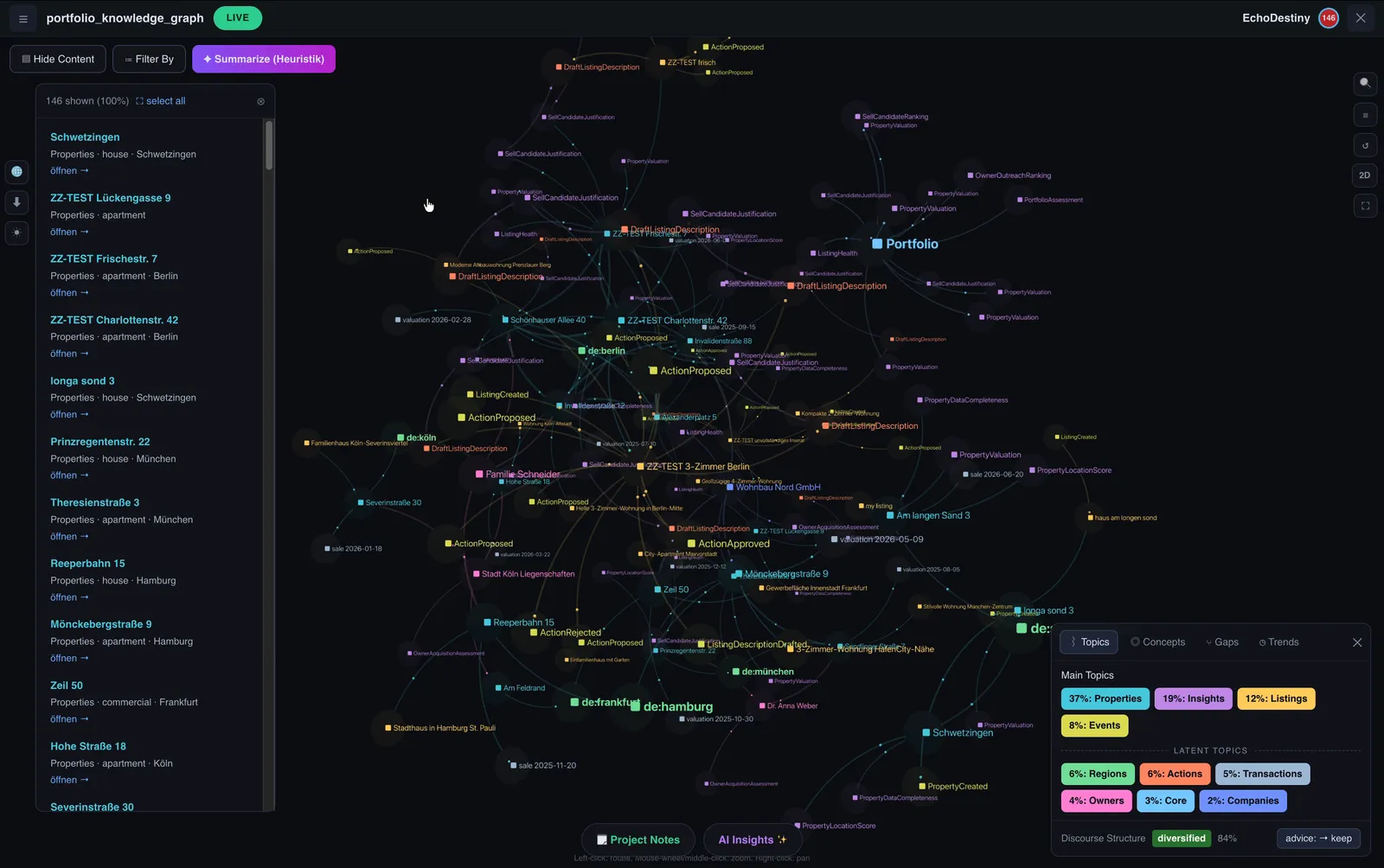
A quick look at the knowledge graph in action — shown here: the Real Estate module.
Notes are embedded using Vertex AI in the europe-west1 region. Every tenant’s graph, notes, and embeddings are kept separate from every other tenant’s. Data stays until you delete it — deleting a note removes it and its embeddings together, in one transaction, so nothing is left behind by accident.
It’s deterministic. The graph is projected directly from the real entities and relationships in your database — properties, owners, notes, events, and more. No language model draws, invents, or interprets the graph structure itself.
The note and every embedding generated from it are deleted together in a single transaction. Nothing partial is left behind, and nothing is recoverable afterward.
No. The copilot only states facts that come from your own data or a connected source. If a fact isn’t available — because the data isn’t there or a source isn’t connected — it tells you that directly instead of guessing.
In the EU. Note embeddings are generated through Vertex AI in the europe-west1 region, and your portfolio data stays tenant-isolated from every other customer.
Semantic search finds notes that match the meaning of your question, even if the wording differs. It runs alongside literal keyword matching, and the copilot marks which answers come from a literal match and which from a semantic one.
Up to 200,000 characters — enough for a detailed due-diligence write-up, a full call transcript, or a long negotiation history.
No — it’s a platform capability. The Second Brain is live first in EchoDestiny Real Estate Intelligence today, with the same knowledge graph, notes, and grounded copilot built to extend into GEO and every module that follows.
The Second Brain is the knowledge layer of both applications. In Real Estate Intelligence it connects every property, owner and insight in your portfolio. In Portfolio Intelligence it connects securities to executives, sales markets, major shareholders and regulators — every connection with its evidence, source and date. Pick the one your money is in.